


The Great Exit: Why More Americans Are Buying Businesses Instead of Climbing Corporate Ladders
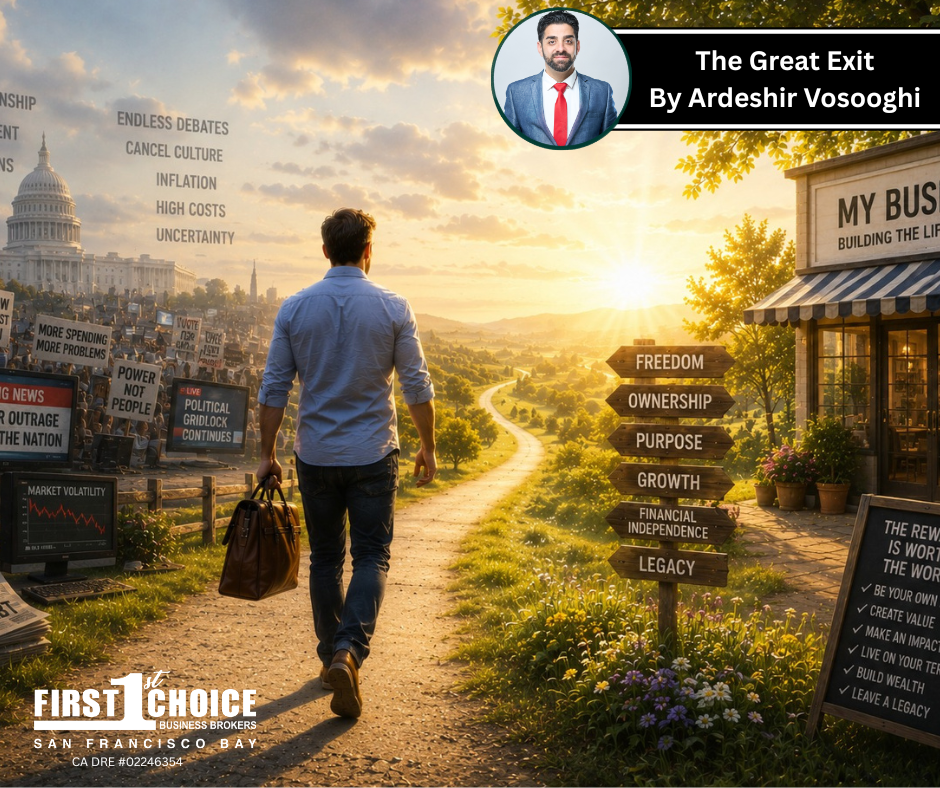
There’s a quiet migration happening in America.
Not across borders. Across mindsets.
Every week now, I speak with professionals who are exhausted by corporate instability, layoffs dressed up as “restructuring,” and the strange modern reality of giving your best years to institutions that may not know your name by next Tuesday.
Some are engineers. Some are healthcare professionals. Some are middle managers who survived three rounds of layoffs only to realize survival is not the same thing as living.
And increasingly, they’re asking the same question:
“What if I just bought my own business?”
For years, entrepreneurship was romanticized as the startup world - hoodies, venture capital, apps promising to deliver toothpaste by drone. But the real backbone of America has always been something quieter and sturdier: the small business owner.
- The person who owns the neighborhood shop.
- The local manufacturer.
- The service company.
- The logistics operation.
- The barber shop.
- The HVAC company.
- The restaurant.
- The auto repair shop.
The people who know their customers by name and don’t need a TED Talk to explain what value creation means.
And despite wars overseas, supply chain instability, inflation, tariff uncertainty, and brutal weather events impacting entire regions, the small business sector has shown something remarkable over the last year:
Resilience.
According to recent SBA data, small businesses still account for 99.9% of American businesses and employ nearly half the private workforce. Meanwhile, multiple 2026 business outlook reports show business owners remaining cautiously optimistic, with strong expectations for revenue growth despite ongoing economic pressure.
That matters.
Because while giant corporations have spent the last few years trimming payrolls and consolidating power, many small businesses have quietly adapted. They’ve embraced AI tools, diversified suppliers, refined operations, and become leaner and smarter. The survivors of the last few years are not weak operators. Many are battle-tested.
And now another force is entering the equation:
Demographics.
America is heading into one of the largest ownership transitions in modern history. Baby boomer business owners are aging out. Many built incredible businesses over decades and now want retirement, relief, or simply peace. But their children often do not want the business.
That creates opportunity.
Not fantasy opportunity.
Real opportunity.
A buyer today can often acquire an already functioning business with employees, customers, cash flow, systems, equipment, and goodwill already in place - something that would take years and enormous capital to build from scratch.
That’s why business brokerage activity has remained surprisingly active despite higher interest rates and lending caution. SBA lending still showed strong volume through the last year, particularly among buyers seeking stable “main street” businesses with proven operating history.
But let’s pause the motivational soundtrack for a moment.
Because this is where people get hurt.
Tony Robbins once famously said:
“The path to success is to take massive, determined action.”
And he’s right.
Sometimes people stay in dead-end careers because fear becomes furniture. Comfortable. Familiar. Heavy.
But Zig Ziglar offered the balancing wisdom:
“Success occurs when opportunity meets preparation.”
That’s the brake pedal.
Owning a business is not passive income wrapped in a motivational Instagram reel. It is responsibility. Stress. Payroll. Customer complaints. Tax filings. Staffing problems. Insurance renewals. Equipment breakdowns at the worst possible time.
Sometimes you are the CEO and the janitor in the same afternoon.
A good business can give you freedom.
A poorly chosen business can hand you a second job with a larger anxiety budget.
That’s why due diligence matters so deeply. Buyers should understand the books, the operational realities, industry risks, staffing requirements, lease terms, and financing structure before jumping in. Excitement is fuel. Analysis is steering.
Still, something beautiful happens when people step into ownership with clear eyes.
They begin building equity for themselves instead of endlessly building it for shareholders they will never meet.
They gain control over their schedule, direction, culture, and future.
They rediscover something corporate systems often drain from people:
Agency.
And perhaps that’s the real trend emerging in business brokerage right now.
Not greed.
Not hustle culture.
Not “get rich quick.”
Meaning.
People want work that feels connected to reality again. Tangible. Human. Grounded. They want to look at the thing they built and say:
“That exists because I showed up.”
In a strange way, the turbulence of the last few years - the wars, inflation, political division, climate shocks, supply chain chaos - has reminded people how fragile large systems can be. And that realization has pushed many toward something smaller, more local, and more understandable.
The village is calling people back.
Not everybody should buy a business.
But many more people are capable of it than they realize.
And for the right person - prepared, informed, humble enough to learn, and brave enough to act - business ownership may not just become a career change.
It may become the first time work truly feels like theirs.
References:
BV Resources; IBBA Market Insights; California Association of Business Brokers (CABB); U.S. Small Business Administration 2026 FAQ Report; U.S. Chamber of Commerce 2026 Small Business Outlook; Bank of America Institute Small Business Checkpoint 2026; Fora Financial 2026 Business Insights Report; OnDeck/Ocrolus Small Business Cash Flow Trend Report 2026.
